By Someone who’s spent a lifetime (I know this makes me sound old, but trust me, I’m not) building virtual worlds, and is now trying to fix the real one.
In all my time working with virtual worlds, games, simulations, visualisation tools, and digital twins, there has always been one constant: structure. The virtual world cannot function on its own, especially if it isn’t complete; everything must connect, including data, logic, geometry, and more. And yet, from what I’ve noticed, in the world of construction and real estate, particularly at the final mile of project delivery, things often fall apart right where they should be coming together.
That’s where digital handover comes in to save the day. To build a structured, intelligent bridge between construction and operations. A system of record that not only delivers what was designed and built, but also preserves its usability long after the project is complete.
In brownfield projects, where infrastructure already exists but documentation struggles to play catch-up, digital handover helps create order by digitising assets and stitching fragmented information into usable digital records in a unified digital space for future use. In greenfield projects, there’s a great chance to get it right from the start by enforcing standards and handing over not just built spaces, but key intelligence on how they work.
It’s easy to think of digital handover as a compliance requirement or a checklist task. But in reality, it’s a lot deeper. It’s the first complete digital narrative (pun intended) of a built environment. A single source of truth for all stakeholders involved, for the future of the building, and to take it even further beyond, for the future of digital twin integrations.
If we were to believe that the physical world deserves the same consistency and precision we demand from our virtual ones, then digital handover, the right way, isn’t just optional anymore. It is essential, to the point where the story of the building finally begins to make sense.
What happens without a Digital Handover?
Let’s take a look at the cost of fragmented, scrambled, and lost documents, for one last time.
- Lost time – Facility Managers spend weeks hunting for O&M manuals, warranties, or floor plans.
- No accountability – No track of who submitted what, when, or even its completion status.
- No digital readiness – BIM, IoT, energy analytics, all don’t mean much if the handover is still a mess.
Now that we’ve established the importance of Digital handover, let’s see what an ideal handover looks like for different types of spaces.
What does an Ideal World look like?
Let’s imagine a world where all Drawings, O&M manuals, Asset registers, Compliance certificates, warranties, and all other documents are kept in a unified digital space, serving as the visual ‘single source of truth’ and becoming the foundation for asset operations, compliance, and digital twins.
What a world, right? Everything works flawlessly, all documents are searchable, queryable, mapped to assets, and are interconnected with various systems of the digital twin.
Now let’s look at some guidelines to follow to achieve that kind of experience, whilst also ensuring the entire process is easy, smooth, and precise.
Now let’s look at some guidelines to follow to achieve that kind of experience, whilst also ensuring the entire process is easy, smooth, and precise.
Let’s begin with the adoption of the PIM -> AIM strategy, and then transition to AIM, from PIM, the digital foundation of the workspace, for every new building we deliver.
1. PIM to AIM
- PIM – for progressive uploads during a project’s design, construction, and commissioning phases (drawings, RFIs, Shop drawings, submittals). Since PIM is collaborative and iterative, it is not final; it remains flexible throughout the project, evolving as the project progresses and builds.
At handover, the relevant parts of the PIM are validated, cleaned, and migrated into the AIM. - AIM – is the official digital record of the built asset post-handover (O&Ms, warranties, asset lists, safety docs, as-built drawings), when all asset-related documents are made available, structured for operation, maintenance, and facilities management and becomes the enduring system-of-record for clients. AIM is a verified, structured, and long-term operational record of a built asset.
Sorting and organising documents this way, with all initial documents and drawings stored in PIM and then transitioning them into AIM upon completion, keeps the process clean and structured, and helps validate all uploaded documents with ease, offering a smooth handover experience.
2. Templates and checklists to adhere to –
With structured templates, progressive tracking, and tagging, we can help digitise documents as clean, usable asset intelligence. Multiple templates allow flexibility for clients based on the availability of documents, making the handover process smooth and seamless, keeping everything connected forever. The following are the two templates we suggest based on your availability of documents and the size of the project –
Basic Template – When limited documents are available.
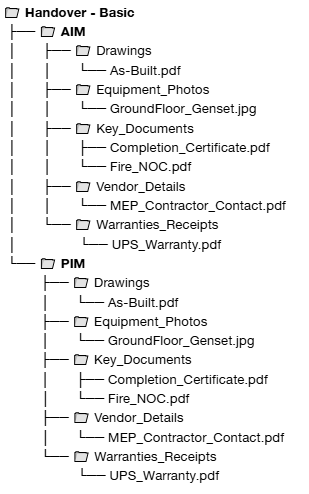
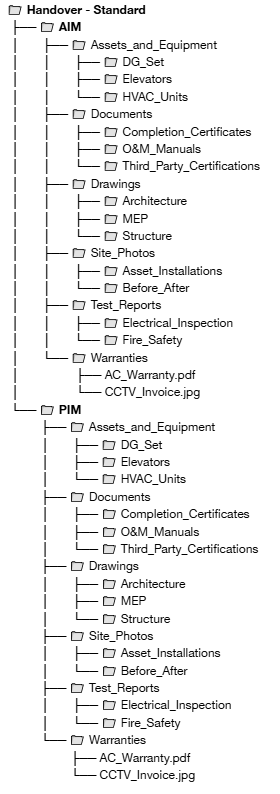
Standard Template – Typical commercial/residential projects.
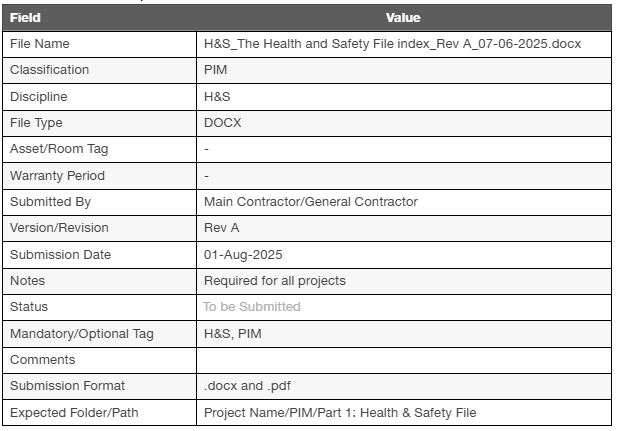
Requirements checklist – Every client is different; their documentation processes, handover standards, and operational needs all vary. These checklists are designed to bring structure to the variability that is the current state of handover, offering flexibility to adapt to client-specific workflows while delivering a uniform, easy-to-use experience across all projects.
Here’s a sample of what the checklist would look like –
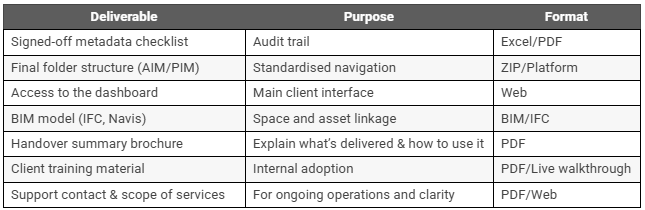
Final deliverables checklist – A checklist for the internal teams to ensure alignment and adherence to what is necessary to deliver a complete handover.
- Why do these templates work?
- Matching Real-World Complexity – These multiple templates (Basic and Standard) exist because not every project is the same.
Basic Template – works when very few documents are available or even possible to collect.
Standard Template – works when working with larger spaces that have or require more documents. - PIM and AIM separation keeps data clean – Organising and uploading documents this way helps progressive uploads, allowing a clean final closeout.
PIM – for progressive uploads during construction or design.
AIM – for the final set used post-handover, or when all asset-related documents are made available. - These templates also help adopt the multi-stage handover process, which eases the handover process, creating feedback loops.
Progressive uploads – The contractor uploads documents whenever ready.
Soft handover – Allows stakeholders to review and request changes.
Final handover – As-builts, completion docs, warranties.
Now that we’ve established what a handover should comprise, what’s next?
Post Handover completion –
- Handover Completion Report – After a digital handover is completed, a concise digital summary is delivered, outlining what was delivered, its structure, and how to access and use it, serving as a Digital Owner’s Manual for all the asset information handed over. It serves a: Legal reference – as it documents what was handed over, when, and by whom, creating an auditable record.
- A reference guide for clients, as it helps clients navigate the AIM/PIM structure and locate key documents with ease.
Support and Marketing asset, as it assists FM teams and contractors during onboarding and operations. - Onboarding for Client Teams – Structured onboarding, despite the platform being intuitive, can ensure adoption and long-term value for clients, in the form of a document or live walkthrough. This contains –
What the platform can do – A clear overview of all features provided as part of the subscription.
How to find what they need – Demonstrates how to navigate folders in the document hub, how to navigate the platform and BIM (if applicable).
Why is it necessary? – Onboarding also covers why these features, the handover and all of it are necessary to the client and why onboarding is important for the digital twin to function efficiently and effectively. - Deliverables Snapshot (Offline) – An offline copy to avoid disputes, changes in FM platforms, and use in audits, so data is not lost even in case of server crashes. This contains –
A snapshot of all files, folders and metadata.
PDFs of the manifest and checklist.
BIM snapshot (non-editable). - Analytics and Audit Logs – Showing transparency to build trust. By giving them tracked usage. Track usage on the platform of the following metrics –
Who accessed what?
The % of documents opened.
Documents last updated. - Add-ons – A well-placed section at the end of the brochure opens future conversations. The following can be done to achieve exactly that –
Extended support for updates – where a designed POC takes care of all handover-related needs and issues, ensuring customer satisfaction. And,
Ongoing FM and compliance validation.
Nice-to-haves –
While all the processes and systems above do a stellar job of getting you started with everything you might need to do a proper handover, a few nice-to-haves to enhance the experience even further don’t hurt, right?
- A Reporting Dashboard – A visual dashboard provides an understanding of what information is available at any given time, allowing you to manage the risk of missing documents at literally any stage of delivery.
- Weekly Summary – Weekly Summaries to keep all the stakeholders updated without manual effort. Imagine an automated report with project progress, issues, pending documents, due dates and more, sent to your inbox every week? So convenient, right?
- BIM preview – Using BIM models to represent assets linked to their respective documents makes things super convenient, giving better context to digital twins.
Over 90% of captured data goes unused without a structured handover, with Facility managers spending a significant amount of time just locating documentation. These systems and templates can solve this by capturing all O&Ms, manuals, drawings, BIM files, and more, saving tons of time.
Digital Handover works on the collection of data. Making data a crucial component of handover, with collection, organisation, storage, analysis, and tagging of documents and information, all play a vital role in this IDEAL Digital Handover solution.
A lot of these features and systems will, more often than not, sit on top of existing BMS systems and documentation that they’ve already been working on for so long. Having the flexibility to customise solutions based on their need, availability of documents, and processes can make the handover process that much easier.
We have spent decades building for physical permanence. It’s time we built for digital continuity, as a building’s story shouldn’t end at handover. With this DIY Handover process, Digital Handover has never been so simple, organised, and complete. Let’s digitise all our projects and deliver on a handover that saves time for everyone.

Prathap R
Senior Unreal Engine Engineer

The views and opinions expressed in this blog are those of the author and do not necessarily reflect the official policy, position, or views of nhance.ai or its affiliates. All content provided is for informational purposes only.