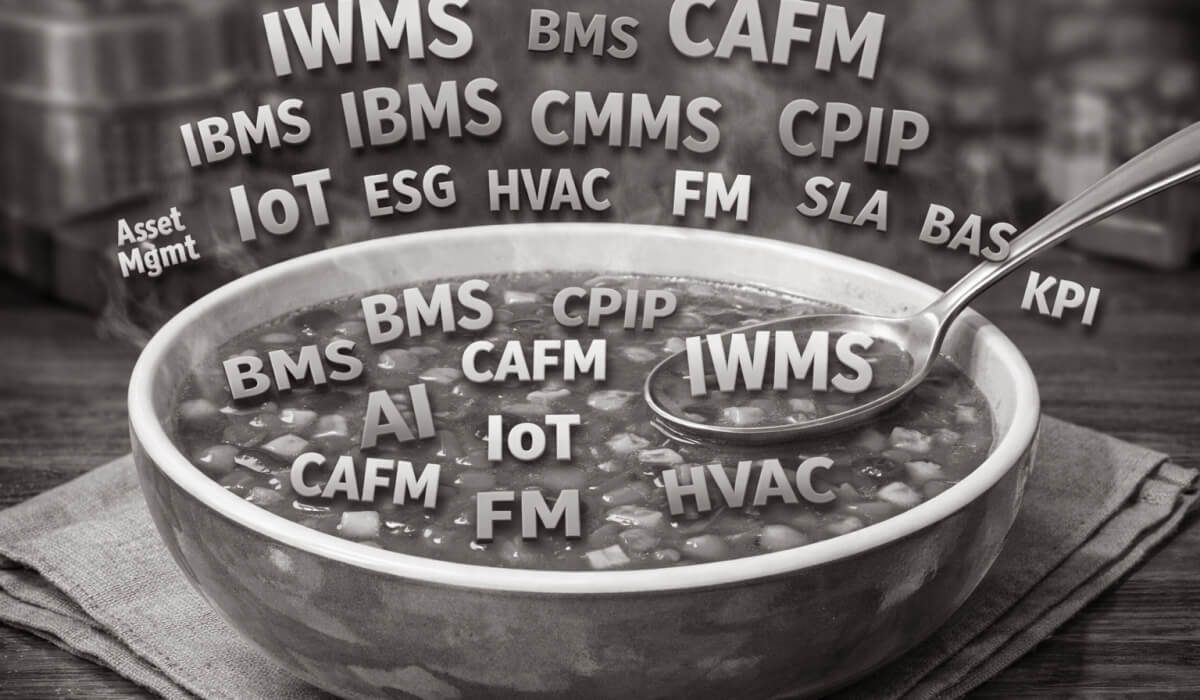
Over the last few years, I’ve found myself in countless conversations with building owners, facility heads, CIOs, sustainability leaders, and sometimes even board members. The conversation often starts innocently enough.
“We’re evaluating an IWMS.”
“We already have a BMS.”
“Our FM vendor uses a CAFM.”
“We want to upgrade to an IBMS.”
“Maintenance is on a CMMS.”
“We’re now hearing about CPIP.”
And then there’s a pause.
Everyone nods, but you can almost hear the unspoken question in the room: Are we talking about five different systems… or the same thing wearing different clothes?
This blog is my attempt to step back from the jargon, strip away the marketing noise, and talk plainly about what all of this actually means if you care about one thing above all else: managing and maintaining a building well.
Not winning a software beauty contest.
Not ticking a buzzword box.
Not buying what the market happens to be selling this year.
But genuinely running buildings that are reliable, efficient, compliant, sustainable, and humane.
The Alphabet Soup Problem in Building Technology
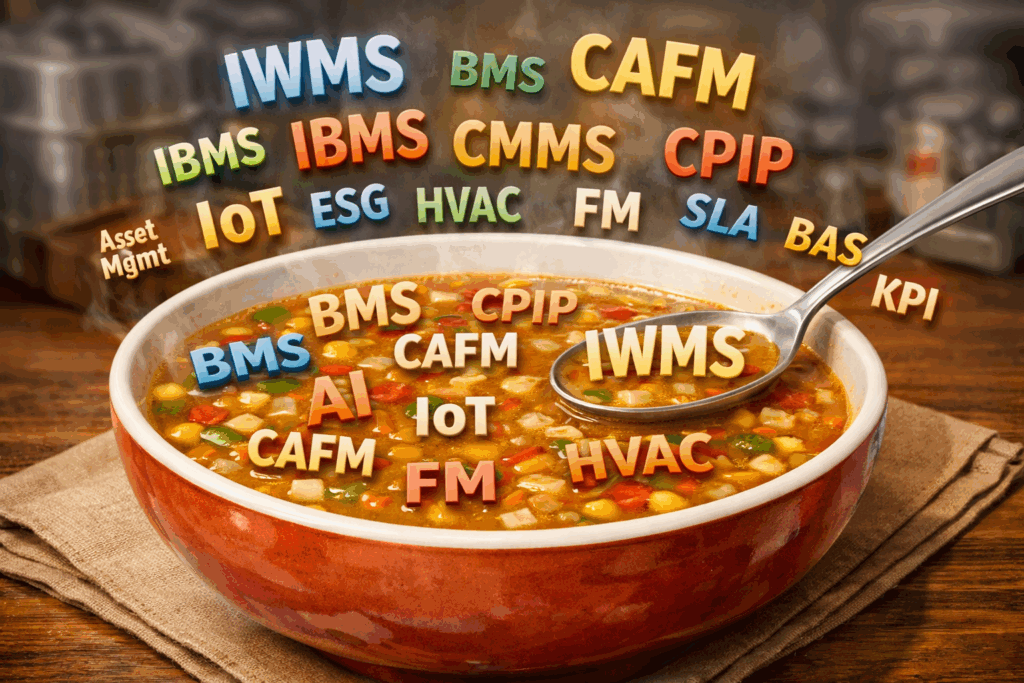
If you’ve been in real estate or facilities for any length of time, you’ve seen this alphabet soup grow thicker every year. New acronyms emerge. Old ones get rebranded. Vendors reinvent themselves with fresher language and shinier slides.
Here’s the uncomfortable truth: most of these terms were created to sell software, not to clarify outcomes.
Each acronym came from a slightly different historical need:
- Operations teams needed control.
- Facilities teams needed records.
- Finance teams needed costs.
- Sustainability teams needed reports.
- Leadership needed visibility.
Instead of converging early, the industry evolved in silos. What we’re dealing with today is the residue of that fragmentation.
So before I explain what each term technically means, let me say this upfront:
If you strip away the labels, every serious building system is trying to answer the same fundamental questions.
The Only Questions That Actually Matter
When I sit with a building owner or operator, I don’t start with acronyms. I start with questions.
What assets do you have, and where exactly are they?
Are they working right now?
How well are they performing compared to design intent?
What is failing, drifting, or wasting energy silently?
Who is responsible for fixing it, and did they actually do it?
How much did it cost you – in money, energy, comfort, risk?
What is likely to break next?
What proof do you have for audits, compliance, or ESG reporting?
What would you change if you could see the whole picture clearly?
Every acronym you’ve heard – IWMS, BMS, CAFM, IBMS, CMMS, CPIP – exists because someone, at some point, tried to answer part of these questions.
The problem isn’t that these systems exist.
The problem is mistaking partial answers for complete truth.
BMS: The Nervous System of the Building
Let’s start with the most foundational layer: the Building Management System.
A BMS was never designed to be strategic. It was designed to be operational.
At its core, a BMS connects directly to physical equipment – HVAC, chillers, AHUs, VAVs, lighting panels, meters, pumps. It reads sensor values and sends control commands. Temperatures, pressures, flows, statuses, alarms.
Think of it as the building’s nervous system. Fast, real-time, reactive.
But here’s where confusion begins.
A BMS knows what is happening right now.
It does not inherently know:
- Why something is happening
- Whether it is good or bad in a broader context
- How it affects costs, comfort, or carbon
- What happened last quarter in a meaningful narrative sense
A BMS is necessary. It is never sufficient.
IBMS: Same Core, Bigger Ambition
Integrated BMS, or IBMS, entered the vocabulary when buildings became more complex and vendors started stitching multiple subsystems together.
HVAC plus lighting.
Fire plus security.
Meters plus lifts.
Sometimes even parking and access control.
The promise of IBMS was simple: one pane of glass.
In reality, IBMS often became:
- Multiple vendor systems loosely integrated
- Data normalized just enough to visualize
- Control still locked inside individual domains
IBMS is an evolution, not a revolution. It still lives close to real-time operations. It still struggles with long-term intelligence unless paired with higher-level platforms.
CAFM: The System of Record for Facilities
Computer Aided Facility Management systems came from a very different place.
CAFM wasn’t built for live control.
It was built for order.
Drawings. Space records. Asset registers. Maintenance schedules. Service contracts. Helpdesk tickets. SLAs.
If BMS is the nervous system, CAFM is the filing cabinet – and I mean that respectfully.
CAFM answers questions like:
- What assets exist?
- What space is allocated to whom?
- What is the planned maintenance schedule?
- What work orders were raised and closed?
Where CAFM struggles is reality drift.
Buildings are living systems. Assets get replaced. Spaces get reconfigured. Sensors fail. Usage changes.
When CAFM is not continuously fed by live operational data, it becomes outdated quietly – and dangerously.
CMMS: Maintenance, Focused and Narrow
CMMS deserves its own mention because it often gets bundled incorrectly into everything else.
A Computerized Maintenance Management System is laser-focused on maintenance workflows:
- Work orders
- Preventive maintenance
- Technician assignments
- Spare parts
- Downtime tracking
CMMS systems are brilliant at what they do.
They are also intentionally narrow.
A CMMS usually doesn’t know:
- Whether the asset was running inefficiently before failure
- How its performance affects energy or comfort
- Whether failures are systemic or random
- How maintenance ties back to design intent or ESG outcomes
CMMS answers “Was it fixed?”
It rarely answers “Why did it break in the first place?”
IWMS: The Enterprise View of the Workplace
Integrated Workplace Management Systems emerged when real estate portfolios grew larger and more complex.
IWMS tried to connect:
- Real estate
- Space management
- Capital projects
- Facilities
- Finance
- Sometimes sustainability
In theory, IWMS is the bridge between buildings and the boardroom.
In practice, many IWMS platforms remain heavily process-driven and form-based. They excel at governance, approvals, reporting structures, and enterprise workflows.
Where IWMS often struggles is deep operational truth.
Without tight integration to BMS, sensors, and live data, IWMS risks becoming a beautifully organized abstraction of a messy physical reality.
CPIP: The Portfolio Intelligence Layer
CPIP is a newer term, and I’ll admit upfront – it reflects how the industry is trying to correct itself.
Connected Portfolio Intelligence Platforms aim to unify:
- Real-time operational data
- Historical performance
- Asset context
- Maintenance outcomes
- Energy and sustainability metrics
- Portfolio-level comparisons
This is where the conversation finally shifts from systems to signals.
A CPIP mindset asks:
- What patterns are emerging across buildings?
- Which assets are chronic underperformers?
- Where is energy waste structural versus behavioral?
- Which sites need attention now, and which can wait?
- How do decisions taken today show up in outcomes six months later?
Whether a vendor calls it CPIP or not is irrelevant. The capability is what matters.
Why Names Matter Less Than Outcomes
Here’s the blunt reality I’ve learned the hard way.
Two vendors can both sell “IWMS” and deliver radically different value.
One “BMS upgrade” can make a building smarter – or simply newer.
One “AI-powered platform” can generate insight – or just prettier dashboards.
The acronym doesn’t run your building.
The architecture of information flow does.
What you should be evaluating is not:
- What is this system called?
But:
- What signals does it capture?
- How clean is the data?
- How quickly does insight emerge?
- How easily can humans act on it?
- How well does it age with the building?
Distilling Signal from Noise
This is the heart of it.
Modern buildings generate absurd amounts of data. Thousands of sensors. Millions of data points. Endless alerts.
Noise is not the absence of data.
Noise is data without context, priority, or consequence.
Signal is when the system tells you:
- This matters
- This is why
- This is what to do next
- This is what will happen if you don’t
Every platform – BMS, CAFM, IWMS, CMMS – should be judged on how well it helps you move from noise to signal.
What You Should Actually Focus On
If I were advising a building owner, operator or occupier starting fresh today, I’d say this.
Stop shopping for acronyms.
Start designing for capabilities.
Focus on whether your ecosystem can:
- Create a single source of truth for assets and spaces
- Combine live operational data with historical context
- Tie maintenance actions to performance outcomes
- Translate technical metrics into business language
- Support sustainability, compliance, and reporting without manual gymnastics
- Scale across buildings without multiplying complexity
- Evolve as regulations, technologies, and expectations change
A building is not static.
Your systems shouldn’t be either.
The Quiet Shift Happening Right Now
What gives me optimism is that the industry is changing.
AI is forcing platforms to become opinionated.
Digital twins are forcing spatial and asset accuracy.
ESG pressures are forcing traceability.
Occupant experience is forcing human-centric design.
Slowly, the walls between BMS, CAFM, IWMS, CMMS are eroding.
Not because vendors suddenly became generous – but because reality demanded it.
A Final Thought
If you take one thing away from this long reflection, let it be this:
Buildings don’t fail because of missing software.
They fail because of fragmented understanding.
The future of building management is not another acronym.
It’s clarity.
Clarity of data.
Clarity of responsibility.
Clarity of outcomes.
Everything else is noise.
Author:

Krishna Prasad
Chief Product Officer

The views and opinions expressed in this blog are those of the author and do not necessarily reflect the official policy, position, or views of nhance.ai or its affiliates. All content provided is for informational purposes only.