
Buildings are getting smarter, but the tools used to manage them have barely evolved. Facility managers still juggle disconnected dashboards for air quality, energy consumption, occupancy tracking, asset maintenance, and meeting room bookings. Each system speaks its own language, generates its own alerts, and demands its own experiences. The result? Information overload, delayed responses, and decisions made in silos.
At nhance.ai, we asked ourselves a fundamental question: What if a building could think for itself? What if, instead of a facility manager navigating ten different systems, they could simply ask a single intelligent interface—and get answers, insights, and actions across every building system in real time.
That vision is Maverick AI—our multi-agent AI platform purpose-built for smart building operations. And we are building it on top of the Model Context Protocol (MCP), the emerging open standard for connecting AI models to real-world tools and data sources.
Why Multi-Agent Architecture?
Traditional AI assistants work with a single model, a single context, and a single set of capabilities. That approach falls apart in facility management, where the domain knowledge spans HVAC engineering, air quality science, energy optimization, occupancy analytics, asset lifecycle management, and building automation.
A multi-agent architecture solves this by deploying specialized AI agents—each an expert in its domain—that collaborate through a unified orchestration layer. Think of it as assembling a team of specialist consultants who can communicate seamlessly and act together, rather than hiring one generalist who knows a little about everything.
“Instead of building one AI that tries to do everything, we built a team of AIs that each excel at one thing—and gave them a shared language to collaborate.”
At the heart of Maverick AI sits the Model Context Protocol (MCP)—an open standard originally developed by Anthropic and now adopted across the industry. MCP provides a standardized way for AI models to discover and invoke tools, query data sources, and interact with external systems, all without hard-coding integrations.
System Architecture
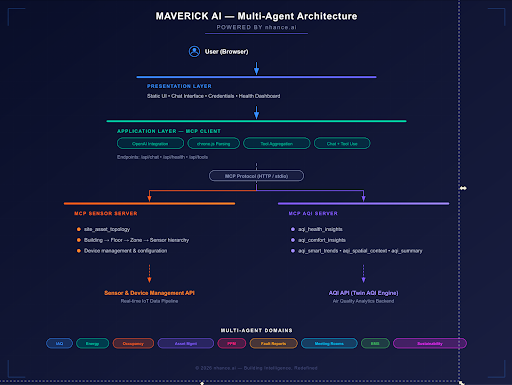
The Agent Ecosystem:
What makes Maverick AI transformative is not just the architecture—it is the breadth of domains we are covering with specialized agents. Each agent is designed to answer domain-specific questions, surface proactive insights, and trigger automated actions.
Indoor Air Quality (IAQ) Agent
The IAQ agent continuously monitors CO₂, PM2.5, VOCs, temperature, and humidity across every zone in the building. It does not just report numbers—it interprets them. Ask “Is the air quality safe for the team on Floor 5?” and it responds with a health-contextualized assessment, not a raw data dump. It detects trends, flags anomalies, and can recommend HVAC adjustments before occupants even notice a problem.
Energy Management Agent
Energy waste in commercial buildings accounts for nearly 30% of total consumption. Our energy agent tracks real-time consumption across HVAC, lighting, plug loads, and renewable sources. It identifies patterns—like HVAC running at full capacity in unoccupied zones—and surfaces actionable recommendations. It can compare consumption against benchmarks, forecast costs, and help facility managers hit sustainability targets.
Occupancy Analytics Agent
Understanding how people use a building is the key to optimizing everything else. The occupancy agent integrates data from PIR sensors, desk sensors to provide realtime and historical occupancy insights. It answers questions like “Which floors are consistently underutilized on Fridays?” or “What is the peak occupancy for Building this month?”—enabling data-driven space Planning.
Asset Management Agent
Every building is a complex web of assets—from AHUs and chillers to fire panels and elevator systems.
The asset agent maintains a complete digital twin of the asset hierarchy, tracks maintenance history, monitors warranty status, and surfaces assets approaching end of life. Ask “Which AHUs are overdue for filter replacement?” and get an instant, prioritized answer.
Planned Preventive Maintenance (PPM) Agent
Reactive maintenance is expensive and disruptive. The PPM agent manages the entire preventive maintenance calendar, auto-generates work orders based on equipment runtime and condition data, and ensures compliance with regulatory schedules. It can brief a facility manager on the week’s maintenance priorities in seconds.
Fault Reporting Agent
When something breaks, speed matters. The fault agent accepts natural language fault reports (“The AC in Meeting Room 3B is making a loud noise”), classifies severity, assigns it to the right team, and tracks resolution. It correlates faults with asset history and sensor data to provide technicians with context before they even arrive on site.
Meeting Room Occupancy Agent
Ghost meetings—booked rooms that sit empty—are one of the biggest productivity drains in modern offices. The meeting room agent monitors real-time occupancy of every bookable space, detects no-shows, and can auto-release rooms amer configurable timeout periods. It provides utilization dashboards and helps optimize meeting room allocation based on actual usage patterns.
Building Management System (BMS) Agent
The BMS agent serves as the conversational layer on top of your existing building automation system.
Rather than navigating complex BMS interfaces with hundreds of data points, facility managers can ask “What is the chiller plant efficiency right now?” or “Reduce the setpoint on Floor 7 by 1 degree.” It bridges the gap between traditional BMS controls and modern AI interaction.
How It Works in Practice
Imagine Sarah, a facility manager responsible for a 200,000 sq m commercial campus with three buildings. It is Monday morning, and she opens Maverick AI.
She types: “Give me a morning briefing.”
Within seconds, the MCP Client routes this request across multiple agents. The IAQ agent reports that CO₂ levels in Building C’s ground floor have been elevated over the weekend, likely due to a ventilation scheduling error. The energy agent flags that Building A consumed 18% more energy than its baseline last week. The PPM agent notes three overdue maintenance tasks. The meeting room agent reports that 40% of booked rooms yesterday went unused.
Sarah responds: “Raise a fault ticket for the ventilation issue in Building C, and show me the energy breakdown for Building A.”
The fault agent creates the ticket, assigns it to the HVAC team with full context. The energy agent generates a visual breakdown by system and zone. All within a single conversation. No dashboard switching. No manual data correlation. No wasted time.
If You Want Your Building to Be Smart, nhance.ai Is the Place
Smart buildings are not about more sensors or bigger dashboards. They are about intelligence—the ability to understand, reason, and act across every system that keeps a building running. Maverick AI brings that intelligence to facility managers through a single, conversational interface powered by a team of specialized AI agents. Whether you manage a single office building or a portfolio of commercial campuses, nhance.ai is building the future of facility management. And with Maverick AI, that future is already here.

Sharad Shankar Suryawanshi
Principal Engineer

The views and opinions expressed in this blog are those of the author and do not necessarily reflect the official policy, position, or views of nhance.ai or its affiliates. All content provided is for informational purposes only.